AutoServe WIP
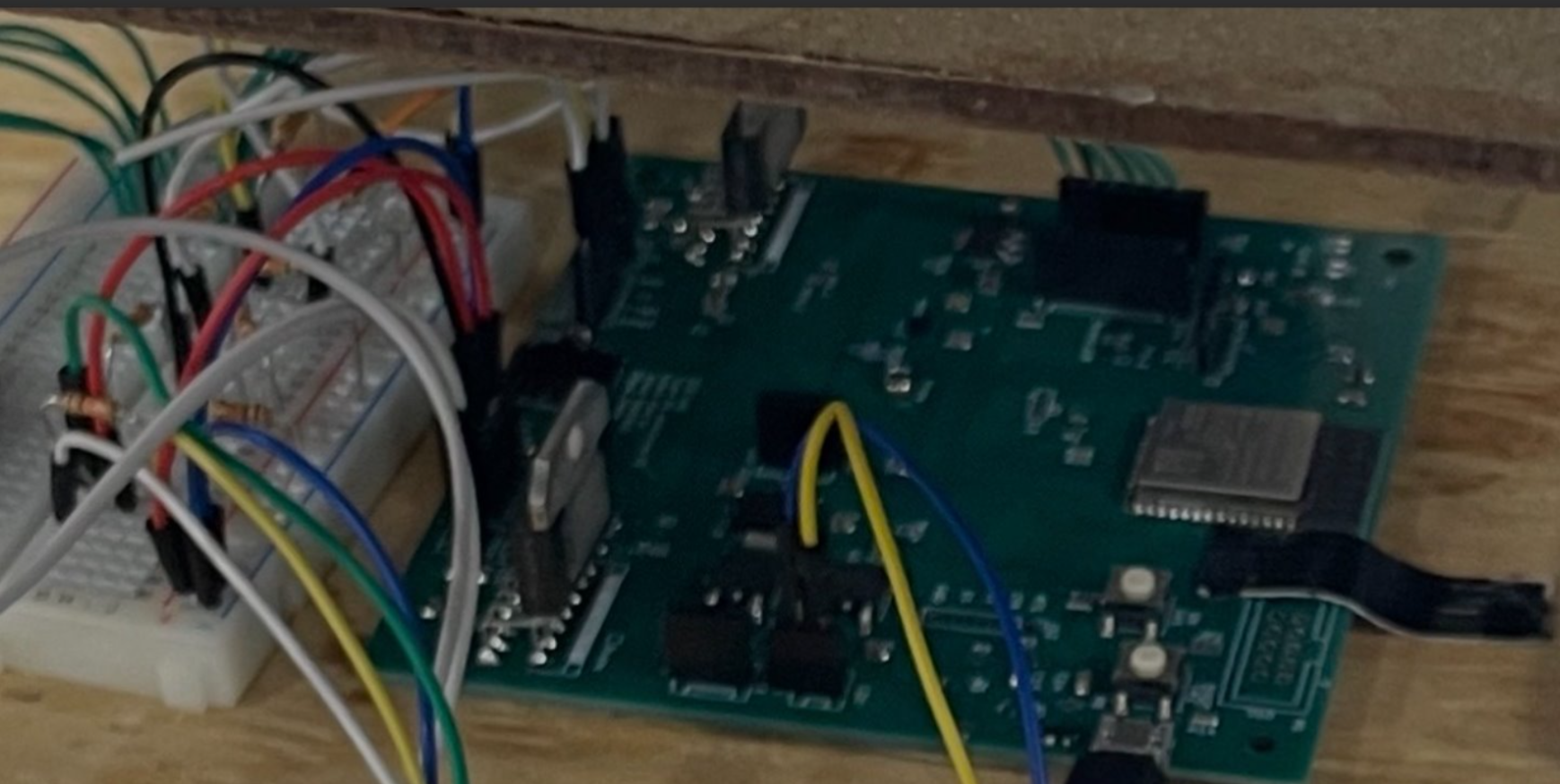
Early Demo
Overview
AutoServe is an autonomous indoor delivery robot designed to carry up to 10 lbs of payload between locations in a multi-floor building such as a hotel. Staff load items at a central base station and specify a destination room; the robot navigates hallways autonomously along a A*-computed path, avoids unexpected obstacles in real time, and handles elevator entry and exit using barometric floor detection.
An ESP32-S3-WROOM-1-N16 handles all onboard sensing, motor control, odometry, and WiFi communication. A companion computer application runs an A* path search on a pre-loaded grid map of the floor plan (1 ft² tiles, walls and fixed obstacles pre-marked) and sends an ordered list of motion vectors to the robot over WiFi. The physical platform is 7×10 inches, with two 6-inch hall-encoder DC drive wheels and two passive caster wheels, built with help from the ECE Machine Shop.
Progress
Subsystems
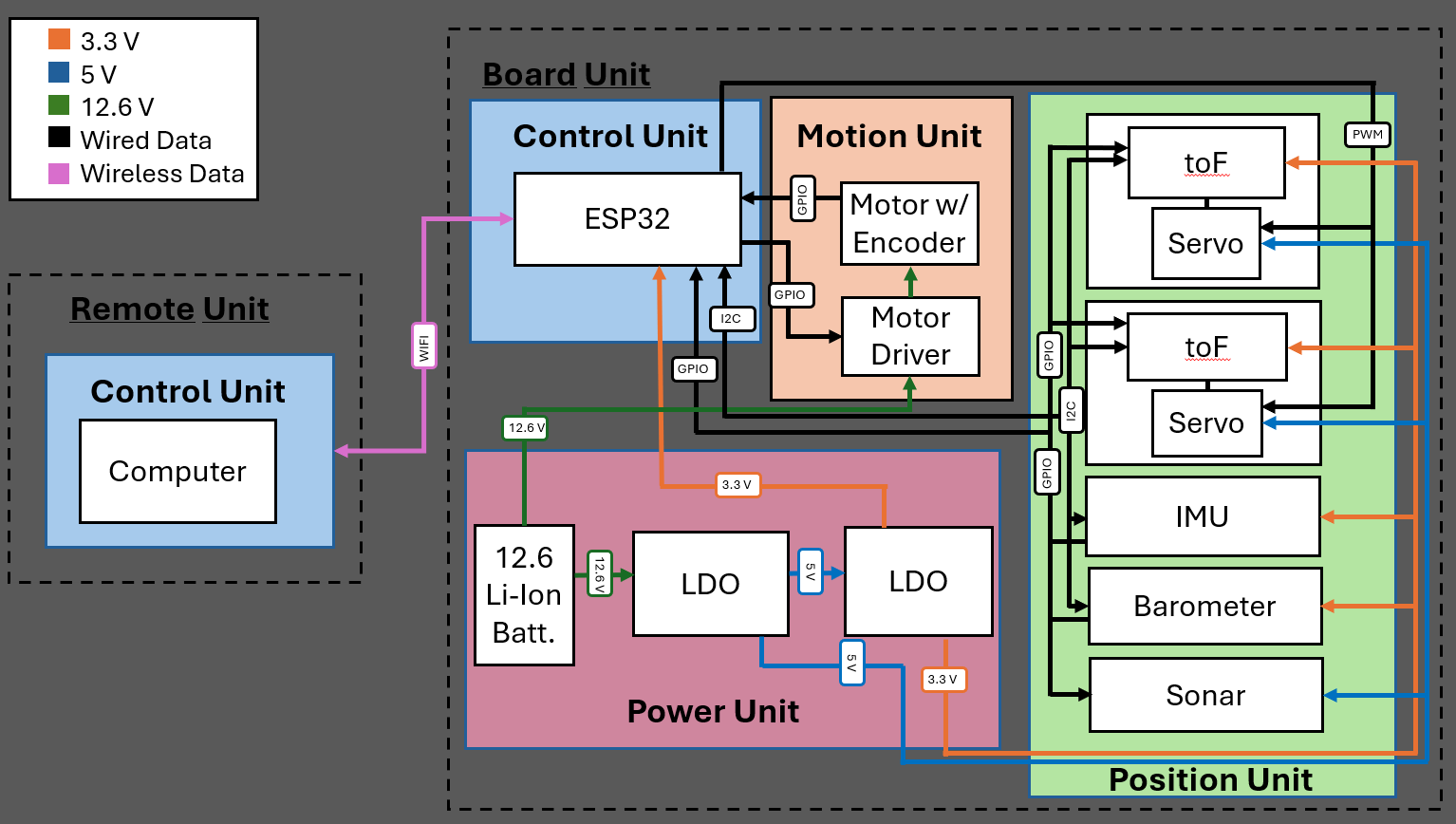
The following block diagram shows the electrical architecture of the AutoServe robot. The ESP32-S3-WROOM-1-N16 microcontroller coordinates motor control, sensor acquisition, and communication with the base computer. Two linear regulators generate 5V and 3.3V rails: the ESP32 and most sensors run from 3.3V, while peripherals like the ultrasonic sonar use 5V. Drive motors are powered by the 12V battery through motor driver circuits controlled via GPIO signals from the ESP32, with hall-effect encoders providing feedback. Additional GPIO lines interface with the ultrasonic sonar, receive interrupt signals from the I²C sensors, and control the startup of the time-of-flight sensors, while PWM outputs drive scanning servos, enabling coordinated sensing and autonomous navigation.
Block Diagram of the AutoServe robot.
Control
- ESP32-S3-WROOM-1-N16 — all onboard processing
- WiFi to base computer for path commands & status reporting
- GPIO to motor drivers, encoder feedback lines and Sonar
- I2C bus: IMU, barometric sensor, Time of flight
- Powered by 3.3V LDO at 1Amp
Motion
- Two 12V hall-encoder DC geared motors (130 RPM)
- LMD18245 H-bridge drivers — 3.5A at 12V per motor
- Hall encoder feedback for speed and direction verification
- Directly powered by 12.6V Li-ion at 2A per motor
Position
- VL53L3CXV0DH/1 ToF sensor on servo — rotational obstacle scanning
- Ultrasonic sonar — redundant obstacle coverage (replaces IR)
- LSM6DSO32 IMU — double-integrated for XY position, gyro for heading and motor encoder for rotation
- BMP585 barometric sensor — floor-level Z tracking for elevator traversal
- Motor encoders cross-validate IMU displacement estimates
Power
- 12.6V / 3000mAh rechargeable Li-ion battery (XZ02)
- 12V direct feed to motion subsystem (1A per motor)
- TL494 PWM buck converter: 12V → 5V
- LM3940IT LDO regulator: 3.3V at 1A for ESP32 and sensors
Design Change — Sensing
The original sensing design used four custom infrared obstacle detection circuits consisting of an IR emitter, photodiode receiver, and LM358 comparator stage. A shared digital potentiometer was intended to allow software adjustment of detection thresholds so the robot could tune sensing range dynamically.
These circuits were built and evaluated during early hardware prototyping. Testing revealed unreliable obstacle detection due to large variations in reflected IR intensity across different surface materials and under changing ambient lighting conditions. Dark or low-reflectivity objects frequently failed to trigger detection, while highly reflective surfaces produced inconsistent range thresholds.
To improve robustness, the sensing subsystem was redesigned to use ultrasonic sonar as the primary obstacle detector combined with a servo-mounted VL53L3CXV0DH/1 time-of-flight sensor for directional laser scanning.
PCB Design
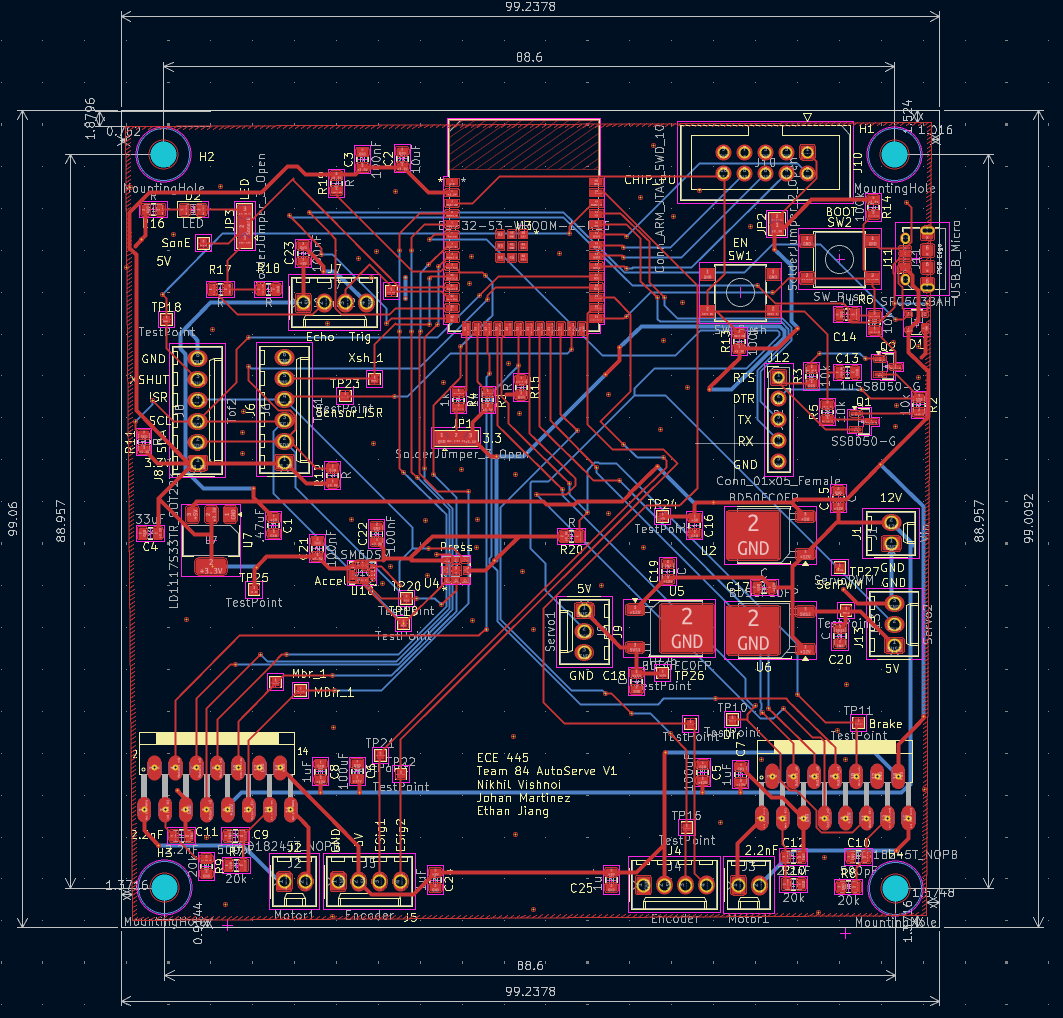
To transition from breadboard prototyping to a reliable embedded platform, the AutoServe electronics were consolidated into custom PCBs designed in KiCad. Two board types were created: a main AutoServe controller board that integrates the majority of the robot electronics, and two small breakout boards for the time-of-flight sensors used in the rotational scanning subsystem.
The main AutoServe PCB integrates the ESP32-S3-WROOM-1-N16 microcontroller module, dual LMD18245 motor drivers, power regulation circuitry, and sensor interfaces into a single board. Battery input from the 12.6V Li-ion pack feeds the motion subsystem directly, while onboard regulation generates 5V and 3.3V rails for logic and sensors. The board also routes encoder inputs, I²C sensor buses, and GPIO control signals needed by the motion and sensing subsystems.
Two identical breakout boards were designed for the VL53L3CXV0DH/1 time-of-flight sensors. These compact boards provide power filtering, I²C connectivity, and mechanical mounting points so each sensor can be attached to a servo motor. This configuration allows the robot to sweep a laser rangefinder across its surroundings to detect obstacles and determine open navigation paths.
At the time of writing, the PCBs have been completed and ordered for fabrication. Hardware bring-up, validation of the power system, and integration with the motor drivers and sensor subsystems will occur once the boards arrive.
AutoServe main controller PCB layout.
Time-of-flight sensor breakout board layout.
Software
The robot runs a finite state machine on the ESP32. The base computer runs an A* search on a pre-loaded grid map and sends a linked list of motion vectors over WiFi. The robot processes these sequentially, checking sensors before each move and verifying actual displacement after each move using fused encoder and IMU data.
- Start — initial boot state where the ESP32 configures peripherals and initializes the onboard WiFi module.
- Startup WiFi — recovery state entered if WiFi initialization fails; repeatedly attempts to restart the WiFi driver until the module becomes operational.
- Connect — waits for the base computer to send an agreed-upon test string verifying that the robot can receive commands.
- Listening — the robot notifies the computer it is ready and fills a linked list of movement commands sent from the computer. Commands begin with a motion start signal and end with either a motion done signal or a no-command termination.
- Sense — the position subsystem polls the obstacle sensors to verify that the next motion segment is clear before the robot moves.
- Move — the motion subsystem receives a vector and distance, computes the required wheel motion, and drives the motors through the motor drivers.
- Halt — immediately stops all motors if an obstacle is detected, preserving remaining movement commands using IMU and encoder feedback.
- Verify — the motion and position subsystems fuse encoder and IMU data to determine the robot’s actual displacement and detect motion error.
- Corrective Motion — calculates and inserts corrective movement commands to compensate for accumulated position error.
- Ride — waits at an elevator entrance and enters when the doors open; the barometric sensor tracks vertical movement while inside.
- Exit — generates movement commands to leave the elevator before resuming the remaining planned route.
- Done — notifies the base computer that the movement list has completed and the robot has arrived at the destination.
The computer-side application runs an A* search on a 1 ft2 tile graph of the floor plan with walls and fixed obstacles pre-loaded. It sends motion commands, handles rerouting if the robot reports a stuck state, and provides a GUI for staff to input delivery destinations.
Future Work
- Autonomous map building to replace pre-loaded static floor plans.
- Extended battery life and increased payload capacity for real deployment scenarios.